
Gold cuff bangles: how to choose, size and wear one
, 7 min read
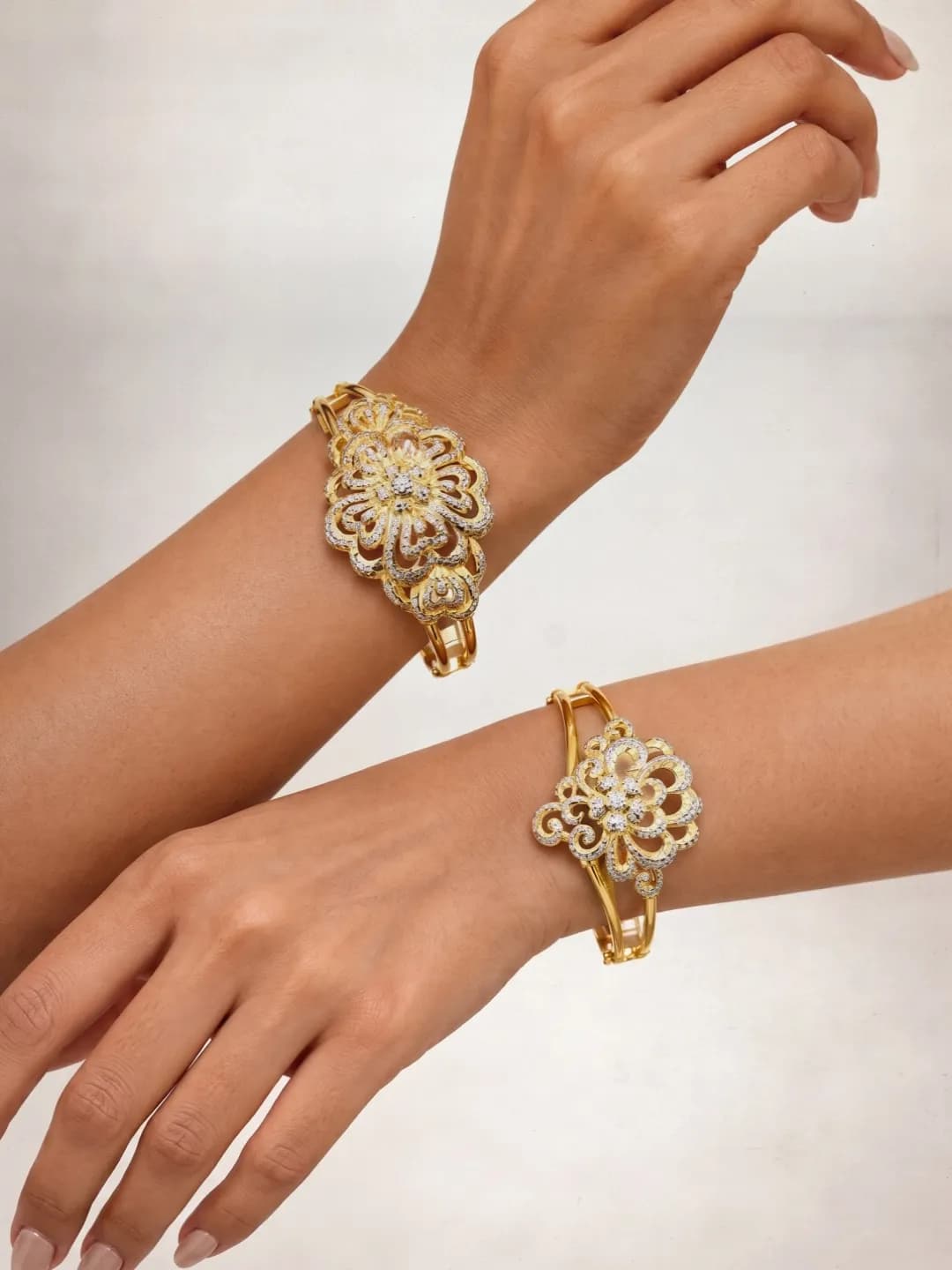
"Two floral cuff bangles, crafted for the moments worth remembering." That was our caption for the photo above: two gold cuffs, one on each wrist, each topped with a large openwork flower. The petals are edged with a fine white sparkle that picks out their outline against the yellow gold, and each flower sits on a split band of two slim gold rods. One flower is broader and rounder; the other is lighter, with curling petals.
A cuff like this is a statement piece, the kind chosen for a wedding, an engagement or a big family occasion. Here is what makes a cuff different from a bangle, how to choose the right size, and how to wear and look after one.
The short answer: a cuff bangle is a rigid bangle with an opening, or a hinge and clasp, so it goes around your wrist instead of over your hand. That means it is sized to your wrist, not your hand, and it should be put on and taken off sideways, never by pulling the ends apart.
Cuff, bangle or bracelet: what is the difference?
- A bangle is a rigid, closed circle. It has no opening, so it must slide over your hand. See our bangle size guide for what sizes like 2.4 and 2.6 mean.
- A cuff is rigid too, but it opens. An open cuff has a gap at the back; a hinged cuff, often called an openable bangle, has a hinge on one side and a clasp on the other.
- A bracelet is flexible: a chain or a band of links that fastens with a clasp. See men's gold bracelets.
In Indian jewellery you will also hear kada for a heavier, often broader bangle, which may be closed or openable.
Open cuff or hinged cuff?
- An open cuff has a gap at the back and no fastening. You slip it on sideways, through the narrowest part of your wrist. It has no moving parts, but it relies on a good fit to stay on.
- A hinged cuff, or openable bangle, is a closed ring in two parts, joined by a hinge on one side and a clasp on the other. It opens wide, closes securely and cannot slip off, which makes it a safer choice for a heavy or valuable piece. Look for a safety catch beside the clasp.
Ask us to show you how each of the cuffs in our photo opens and closes.
How to size a gold cuff
A cuff goes around your wrist, not over your hand, so it is your wrist you measure:
- Wrap a soft tape measure, or a strip of paper, around your wrist at the wrist bone, where the cuff will sit. Keep it snug.
- Measure both wrists. They are not always the same size.
- Compare the measurement with the inside of the cuff, or, better, try it on.
A cuff should sit snugly. It should not spin around your wrist or slide down over your hand, but it should not press or leave a mark either. Because a cuff or openable bangle goes around the wrist, it can fit closer than a closed bangle, which has to clear the widest part of your hand. So if you wear size 2.6 in closed bangles, a cuff that fits you well will usually be smaller across. Our bangle size guide explains the sizes.
How to put on a cuff without bending it
A gold cuff is rigid, and gold is a soft metal. Each time a cuff is pulled open and squeezed shut, the gold at the bend hardens and becomes more brittle, and in time it can crack, like a wire bent back and forth. So never pull the ends of a cuff apart to get it on.
To put on an open cuff:
- Relax your hand. Your wrist is narrowest when it is relaxed.
- Turn your wrist so its narrow side, not the top, faces the gap.
- Press the narrow side of your wrist into the gap and ease the cuff on.
- Turn the cuff a quarter of the way round, so the flower sits on top.
To take it off, turn the gap back to the narrow side of your wrist and ease it off the same way. If a cuff will only go on when you bend it open, it is too small.
To put on a hinged cuff, open the clasp fully, set the cuff around your wrist, close it until it clicks and fasten the safety catch.
How to wear floral cuffs
- One on each wrist, as in our photo. Two cuffs with different flowers look like a pair without being identical.
- With slim bangles. A cuff on one wrist and a few slim bangles on the other balances the look. Let the cuff be the statement and keep the rest simple.
- With a saree or lehenga, a cuff shows best with short or three-quarter sleeves, or a sleeve that ends above the wrist.
- For everyday wear, choose a slimmer, smoother cuff. A large openwork flower is best kept for occasions, where it will not knock against desks and keyboards.
For more on the occasions when gold matters, read gold in Indian traditions, and see our bridal jewellery.
Looking after an openwork cuff
- Watch your clothes. Openwork and fine edges can catch on delicate fabrics such as silk, lace and knits. Put the cuff on after you dress, and take it off before you change.
- Store it on its own, in a soft pouch or a lined box, so other pieces cannot scratch it and nothing presses on the flower.
- Clean it gently. Warm water with a little mild dish soap and a soft toothbrush will reach into the openwork; rinse it in a bowl of clean water and dry it thoroughly. Ask us how to clean the white detailing on these two before you soak them. For more, read how to clean gold jewellery.
- Take it off for the gym, swimming and housework, where it can be knocked, bent or exposed to chlorine.
- Have the hinge and clasp checked now and then, especially on a cuff you wear often.
What to check before you buy
- The purity stamp, usually on the inside of the band.
- The weight in grams, written on your receipt. Gold is priced by weight; check today's gold rate.
- How it opens and closes. Ask us to show you, and try it yourself before you pay. A hinged cuff should close with a firm click and have a safety catch.
- The fit, on your own wrist if you can.
- An itemised quote: gold value, making charge and GST as separate lines. See how to check a gold price quote.
Questions people ask about cuff bangles
Is a cuff the same as a bangle?
A cuff is a kind of bangle: rigid, but with an opening or a hinge, so it goes on around your wrist instead of over your hand.
What size cuff should I buy?
Measure your wrist at the wrist bone and choose a cuff that sits snugly without pressing. It should not spin around or slide over your hand. Try it on if you can.
Can a gold cuff be resized?
Sometimes, slightly, by a jeweller. Do not bend it yourself: repeated bending weakens gold. Openwork and hinged cuffs are harder to alter, so ask before you buy whether a piece can be adjusted.
Can I wear a gold cuff every day?
A slim, smooth cuff, yes. A large openwork cuff like the two in our photo is best kept for occasions, where it is less likely to be knocked or snagged.
Are cuff bangles worn at weddings?
They suit weddings and engagements well, for the bride or a guest, worn on their own or with slim bangles. See our bridal jewellery.
See the two cuffs in person
To see the two floral cuffs from our post, or to try cuffs and bangles on your own wrist, visit Minora Jewels at 142 Dunlop Street, inside Haniffa, in Little India, a few minutes from Little India (NE7, DT12) and Rochor (DT13) MRT stations. We are open every day from 10.30am to 9.30pm, and you can walk in any time; no appointment is needed. Ask us for each cuff's weight and today's price. Designs change as new pieces arrive, so follow @minorajewels to see what is new.