
Ring size guide Singapore: chart in mm, US, UK and more
, 7 min read
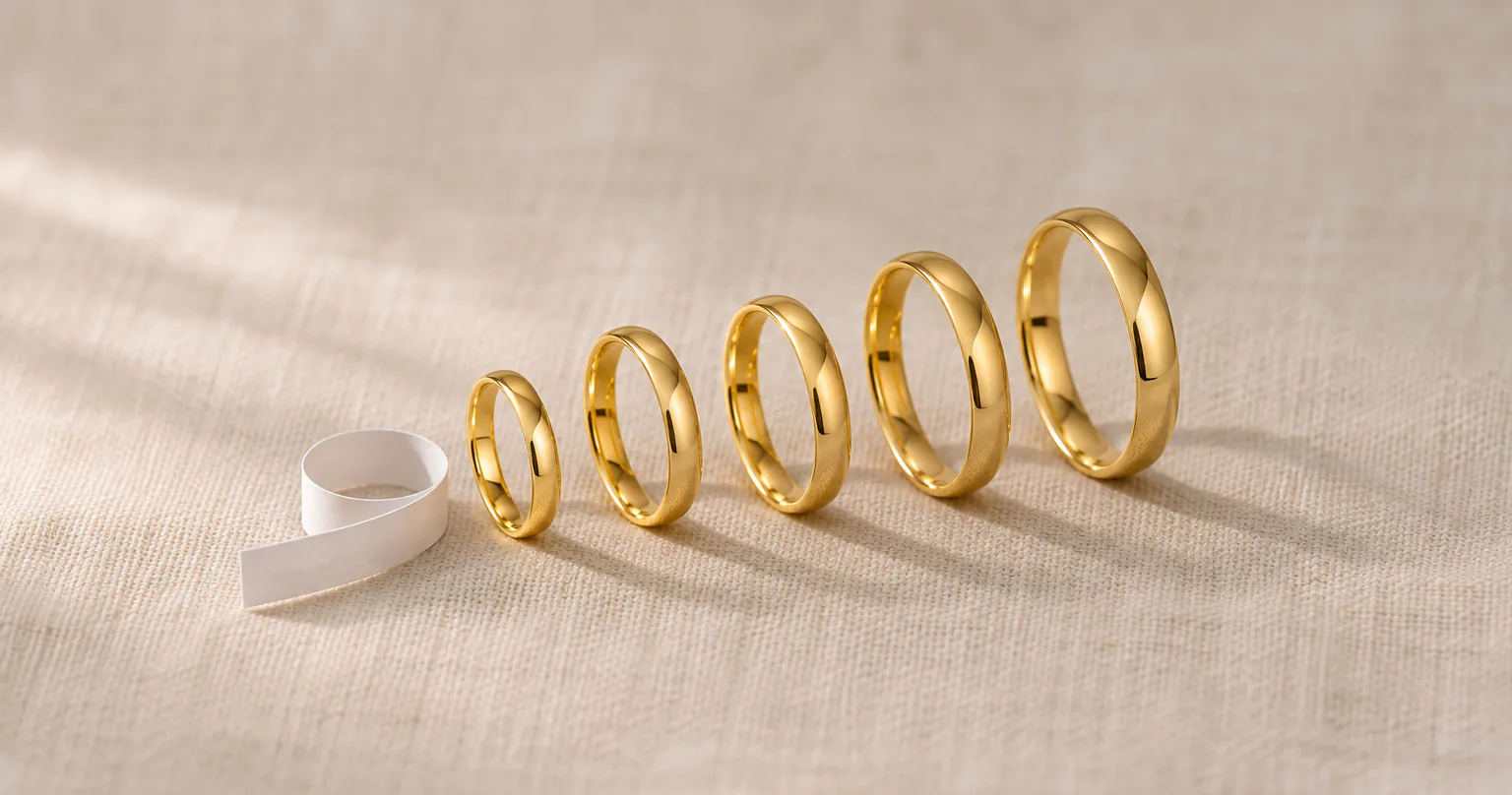
A ring that is too tight will not go over your knuckle, and one that is too loose spins round or slips off when your hands are cold. Ring sizes are confusing because countries number them differently: the same ring can be a US 6, a UK L½ and an ISO 52. Here is how to measure at home, a chart in millimetres, and what to check before you buy.
The short answer: measure the inside diameter of a ring that fits you, or the circumference of your finger with a strip of paper, in millimetres. Then find the nearest row in the chart below. A ring 16.5 mm across the inside, or about 52 mm around, is a US 6, a UK L½ and an ISO size 52.
How do ring sizes work?
Every ring size describes the inside of the ring, not the outside. The thickness of the gold is not part of the size. Different systems simply count it differently:
- ISO 8653 (international): the size is the inside circumference in millimetres. A ring that measures 52 mm around the inside is size 52.
- US and Canada: numbers, in half and quarter sizes. Size 0 is 11.63 mm across the inside, and each whole size adds 0.81 mm to the diameter, or about 2.55 mm to the circumference. The scale grew out of jewellers' ring gauges rather than an official definition; in 1921 the US Bureau of Standards could find no published dimensions for the sizes at all. Our chart uses the usual trade values, which match the Gemological Institute of America's (GIA) chart to within 0.2 mm.
- UK: letters from A to Z, in half sizes. In 1987 the British Standard BS 6820 set each letter at 1.25 mm of circumference. That standard was replaced in 1993 by the British version of the ISO standard, but jewellers still use the letters.
- India and Japan: each has its own number scale. Published conversions to millimetres vary from chart to chart, so we have left them out. If you know an Indian or Japanese size, ask for the inside diameter in millimetres and compare it with the chart.
Ring size chart
"Across" is the inside diameter, which you measure in Method 1. "Around" is the inside circumference, which you match in Method 2. The ISO size is the circumference rounded to the nearest millimetre.
| US | UK | ISO 8653 | Across (mm) | Around (mm) |
|---|---|---|---|---|
| 3 | F½ | 44 | 14.1 | 44.2 |
| 4 | H½ | 47 | 14.9 | 46.8 |
| 5 | J½ | 49 | 15.7 | 49.3 |
| 6 | L½ | 52 | 16.5 | 51.9 |
| 7 | N½ | 54 | 17.3 | 54.4 |
| 8 | P½ | 57 | 18.1 | 57.0 |
| 9 | R½ | 60 | 18.9 | 59.5 |
| 10 | T½ | 62 | 19.8 | 62.1 |
| 11 | V½ | 65 | 20.6 | 64.6 |
| 12 | X½ | 67 | 21.4 | 67.2 |
| 13 | Z+1 | 70 | 22.2 | 69.7 |
The same chart works for women and men. Each US half size adds about 0.4 mm across, or 1.3 mm around.
UK charts do not agree with each other. For a US 6, some give L and others M, because they round to a whole letter in different directions. Our UK column follows the British Standard spacing, which puts a US 6 at L½. If a UK size is all you have, go by the millimetres.
Method 1: measure a ring that already fits
This is the most reliable way to measure at home.
- Choose a ring that is worn on the same finger. Fingers differ in size, and so do your two hands.
- Lay it flat and measure straight across the inside, from inner edge to inner edge, through the centre. Use a ruler marked in millimetres.
- Find the nearest "across" figure in the chart.
For a wide band, measure across the middle of the band, not its edge.
Method 2: measure your finger with a strip of paper
Use paper rather than string or thread, which can stretch and give a false reading.
- Cut a strip of paper about 5 mm wide.
- Wrap it around the base of the finger, where the ring will sit. Keep it snug, not tight.
- Mark where the paper overlaps, lay it flat and measure the length in millimetres.
- Check that a loop of that size will pass over your knuckle. If it will not, measure around the knuckle as well and choose a size between the two.
- Repeat at different times of the day, and find the nearest "around" figure in the chart.
Paper can slip or tear, so treat this as a guide. The international standard notes that jewellers measure fingers with a set of finger gauges, and a check like that is worth having before you buy an expensive ring.
Tips for a comfortable fit
- Time of day and temperature. Fingers swell in the heat and shrink in the cold, and they can measure differently in the morning and the afternoon. In Singapore, a ring that fits in an air-conditioned room can feel tighter outdoors.
- Knuckles. The ring has to slide over the knuckle without falling off once it is on. If your knuckles are much larger than the base of your fingers, ask the jeweller about styles that suit.
- Wide bands. A wide band sits more snugly than a thin one in the same size, so it often needs a slightly larger size. For bands wider than about 4 to 5 mm, ask the jeweller.
- Comfort fit. Bands that are rounded on the inside slip on and off more easily than flat ones. If you are choosing one, try that style before settling on a size.
- Between two sizes. Choose the larger one. It is easier for a jeweller to take metal out of a ring that is too big than to add metal to one that is too small.
How to find someone's ring size without asking
- Borrow a ring they wear on the right finger, and measure it with Method 1. If you cannot take it away, trace around the inside of it on paper and measure the circle across.
- Ask a close friend or family member, who may already know the size or can find out.
- Size up if you are unsure, since a ring that is slightly large is easier to adjust.
- Ask before you buy whether the ring can be resized or exchanged later.
For ideas beyond rings, read buying gold as a gift.
Can a gold ring be resized?
Often, but not always. Many plain gold rings can be made a little smaller or larger by a jeweller, and making a ring smaller is generally easier than making it larger. Rings with stones all the way around, such as eternity rings, are very difficult to resize. Rings with a pattern or engraving all around the band can be distorted by resizing. Ask the jeweller before you buy whether a particular ring can be adjusted later.
Bangles are sized differently
A closed bangle has to pass over your hand, so bangles have their own sizes, such as 2.4 and 2.6, based on the inside diameter in sixteenths of an inch. See our bangle size guide for the chart and how to measure your hand.
Questions people ask about ring sizes
How do I convert a ring size to mm?
Use the chart. For a US size, the inside diameter in millimetres is 11.63 plus 0.8128 times the size, so a US 7 is 17.3 mm across.
What ring size is 52 mm?
A ring 52 mm around the inside is ISO size 52, which is about a US 6 and a UK L½, and 16.5 mm across.
Is a US 7 the same as a UK N?
Close, but not exactly. A US 7 is 54.4 mm around, which falls between UK N and O, at about N½.
Can I measure my ring size with string?
You can, but string can stretch and give a false reading. A strip of paper is better, and measuring a ring that already fits is better still.
Does ring size change?
Yes, a little. Fingers are larger in the heat and smaller in the cold, so measure more than once.
Visit us
If you are choosing a 916 gold ring, bring a ring that fits well to Minora Jewels at 142 Dunlop Street, inside Haniffa, in Little India, a few minutes from Little India (NE7, DT12) and Rochor (DT13) MRT stations. We are open every day from 10.30am to 9.30pm, and you can walk in without an appointment. Browse our 916 gold jewellery, see bridal jewellery for wedding sets, or ask about a custom piece.