
Does gold tarnish? 9K, 18K and 22K gold compared
, 6 min read
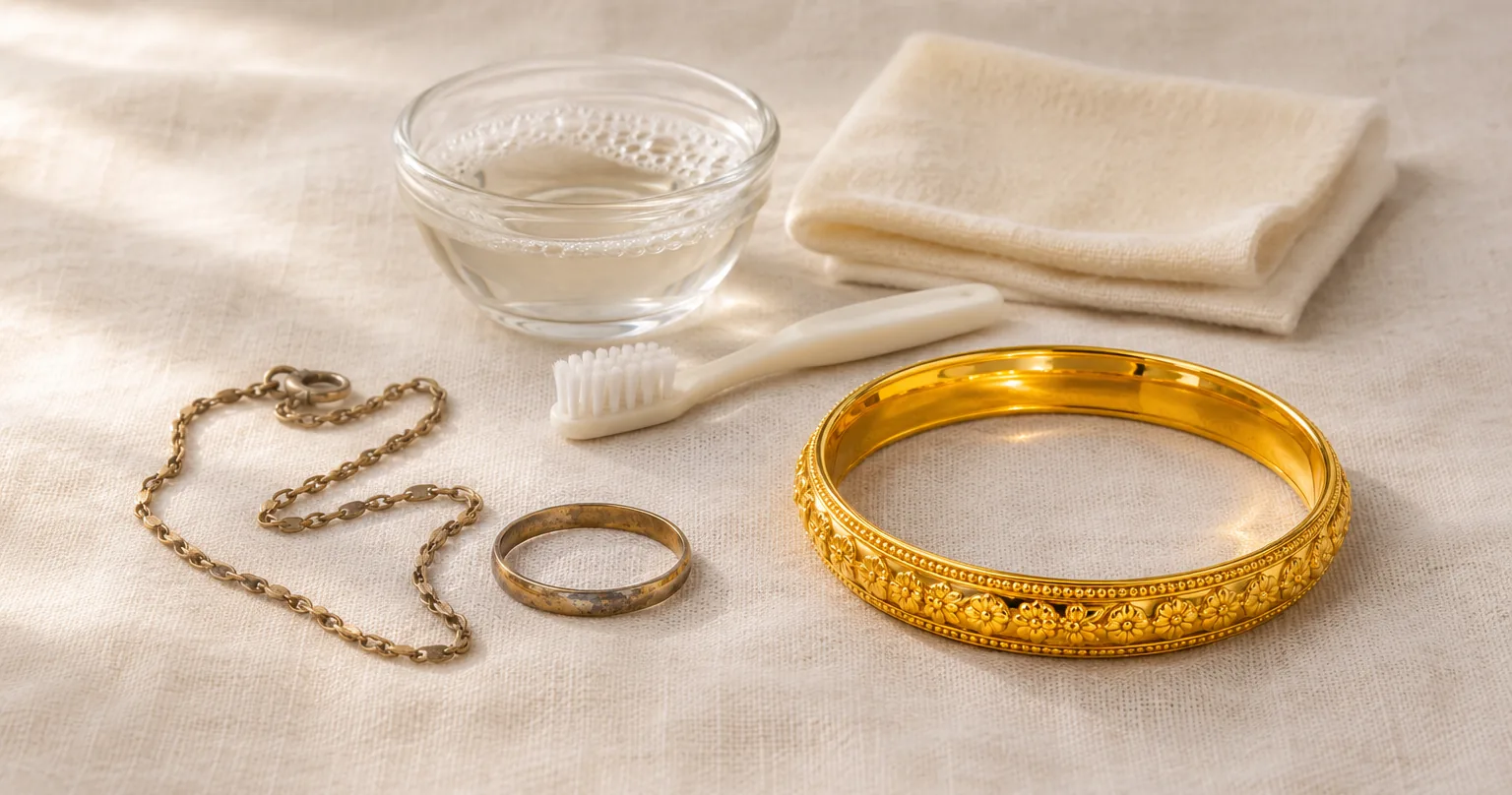
A gold chain that has turned dull, a ring that has left a dark mark on your finger, an old bangle with a brownish film: it is natural to wonder whether gold tarnishes after all. The answer depends on how much gold is in the piece, and on what it meets every day.
The short answer: pure gold does not tarnish. Gold jewellery is an alloy, gold mixed with silver, copper and other metals for strength, and those metals can react with sulphur, chlorine and sweat and darken the surface. The more gold in the alloy, the less it tarnishes. 916 (22K) gold is mostly gold and rarely tarnishes; 9K gold, which is less than half gold, tarnishes much more easily.
Why gold jewellery tarnishes
Gold itself barely reacts with air, water or sweat, which is why gold coins come out of the ground still shining after centuries. Jewellery is a different matter. To make it hard enough to wear, gold is mixed with other metals, most often silver and copper. Those metals are the ones that tarnish:
- Silver reacts with sulphur compounds in the air, in some foods and in sulphur springs, and turns dark.
- Copper reacts with sweat, moisture and chlorine, and can turn dark or greenish.
So "gold tarnish" is really the tarnish of the other metals in the alloy, showing on the surface of the piece.
Does 9K, 14K, 18K or 22K gold tarnish? Purity compared
| Karat | Stamp | Gold content | How likely it is to tarnish |
|---|---|---|---|
| 24K | 999 | 99.9% | Practically never |
| 22K | 916 | 91.6% | Rarely, and only on the surface |
| 18K | 750 | 75% | Occasionally |
| 14K | 585 | 58.5% | More easily |
| 9K | 375 | 37.5% | Most easily |
916 gold, the usual purity for Indian jewellery, is far less likely to tarnish than lower-karat gold, though it is not immune. For more on the stamps, see 916 or 999? Gold purity explained.
Tarnish, dirt or worn plating?
Not every dull piece is tarnished. Before you clean it, work out which of these you are looking at:
- A dull film that comes off on a damp cloth is build-up from skin oils, lotion, perfume and dust. It is not tarnish, and warm soapy water removes it.
- A dark or brownish film, often in the gaps between links or on the inside of a ring, is tarnish on the alloy metals.
- Fine scratches make gold look matt. They are not tarnish either; only polishing removes them.
- A different-coloured metal showing through, usually at the edges and on the parts that rub, means the piece is gold-plated and the plating is wearing off. Solid gold is the same colour all the way through. See solid, hollow or gold-plated?
Why gold leaves a black mark on your skin
A dark smudge on your skin under a ring or bangle is usually not tarnish from the gold. More often, it is tiny particles of metal rubbed off the jewellery by something harder: the fine mineral powders, such as zinc oxide and titanium dioxide, in many sunscreens, foundations and powders. Doctors call this black dermographism. Wash the area with soap and water, and put your jewellery on after your makeup and sunscreen have settled.
A green mark usually comes from copper reacting with sweat. It is far more common with low-karat gold, gold-plated pieces and costume jewellery than with 916 gold.
Does alcohol or hand sanitiser tarnish gold?
No. Rubbing alcohol and the alcohol in hand sanitiser do not tarnish or damage solid gold. Some jewellers even use alcohol to remove grease. But they can harm what is set in the gold:
- Pearls, opals and coral are porous and can be dried out or dulled.
- Emeralds are usually treated with oil, which alcohol can draw out.
- Kundan and polki, set on lac, and pieces with glued stones can loosen.
Hand sanitiser gels also contain thickeners and fragrance that leave a dull film on rings. Let your hands dry fully before you touch your jewellery, and give rings a wash in warm soapy water now and then.
What else makes gold tarnish
- Chlorine, in swimming pools and bleach-based cleaners. Take jewellery off before you swim or clean.
- Sulphur, in hot springs and some foods such as eggs and onions. Take jewellery off before cooking with your hands.
- Sweat and humidity. In Singapore's climate, wipe pieces you wear every day with a soft cloth before you put them away.
- Perfume, hairspray and lotion. Put your jewellery on last.
- Rubber and some paper and cardboard, which can contain sulphur. Store jewellery in a soft pouch or a lined box, not in a rubber-banded bag or a cardboard box.
How to remove tarnish from gold
- Start gently. Soak the piece for a few minutes in warm water with a few drops of mild dish soap.
- Brush the gaps with a very soft toothbrush, then rinse it in a bowl of clean water.
- Dry it, then buff it with a soft cloth or a jeweller's polishing cloth. Skip the polishing cloth on matte, temple and antique finishes, whose look is meant to stay.
This removes most film and light tarnish on 22K and 18K gold. Lower-karat gold that has darkened further may need professional cleaning. Avoid toothpaste, baking soda and scouring powders, which leave fine scratches, and never use bleach. For full steps, and for pieces with stones, pearls or temple finishes, read how to clean gold jewellery.
How to stop gold tarnishing
- Choose higher purity for pieces you will wear every day. 916 gold keeps its colour far better than 9K or 14K.
- Store pieces separately, in a dry, closed box or pouch, away from the bathroom.
- Put jewellery on last and take it off first.
- Wipe it after wearing, especially on hot days.
- Wear it. Gentle wear and regular wiping keep everyday pieces bright.
Questions people ask about gold tarnish
Does real gold tarnish?
Pure 24K gold does not. Gold jewellery contains other metals, and those can tarnish. The higher the karat, the less it tarnishes.
Does 916 gold tarnish?
Rarely. 916 gold is 91.6% gold, so there is little else in it to react. A dull look is more often a film of skin oils and lotion, which washes off.
Does 9K gold tarnish?
More easily than higher karats, because 9K is only 37.5% gold. It cleans the same way: warm soapy water and a soft brush.
Does gold lose its shine?
Gold dulls from build-up and fine scratches, not because the gold itself fades. Washing removes the build-up, and a jeweller can polish out scratches.
Can tarnished gold be restored?
Yes. Light tarnish washes off. Heavier tarnish can be removed by a jeweller's cleaning and polish.
Visit us
If a piece has darkened and you are not sure why, bring it to Minora Jewels at 142 Dunlop Street, inside Haniffa, in Little India, a few minutes from Little India (NE7, DT12) and Rochor (DT13) MRT stations. We are open every day from 10.30am to 9.30pm, and you can walk in without an appointment. Browse our 916 gold jewellery, or check today's gold rate.