
Indian bridal jewellery checklist for a Singapore wedding
, 7 min read
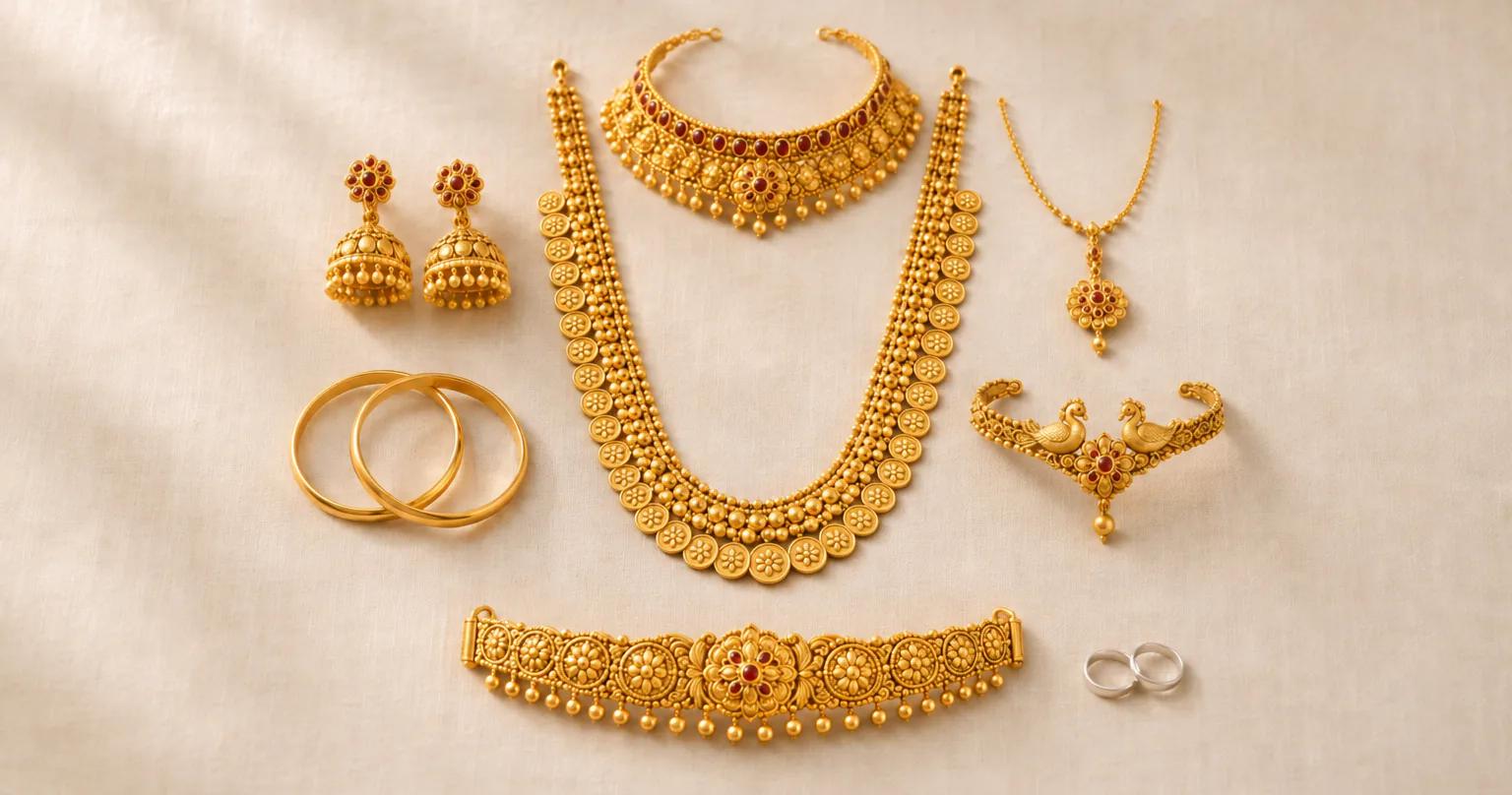
An Indian bride may wear a dozen or more pieces of jewellery on her wedding day, from the parting of her hair to her toes. Which pieces, and what they are called, depends on her community and her family. This checklist sets out the pieces and their common names, then covers timing, budgeting in grams, using family gold and what to check before you pay.
The short answer: many Indian brides wear a marriage necklace (the thali or mangalsutra), one or more necklaces, earrings and bangles. South Indian brides often add a forehead ornament, an armlet, a waist belt and an ornament for the plait. In many South Indian families, anklets and toe rings are silver. Plan the gold in grams, not by set price, and start several months ahead.
Indian bridal jewellery checklist
| Piece | Where it is worn | Common names |
|---|---|---|
| Marriage necklace | Neck, tied at the ceremony | thali, thirumangalyam (Tamil); mangalsutra; minnu (Malayali Christian) |
| Short necklace | Close to the base of the throat | attigai (Tamil), addigai (Telugu) |
| Long necklace | Chest, often layered | haram; coin necklaces such as kasu malai (Tamil) |
| Earrings | Ears | jhumka (Hindi), jimikki (Tamil and Malayalam) |
| Forehead ornament | Along the parting, onto the forehead | nethi chutti (South India), maang tikka (North India) |
| Sun and moon ornaments | Either side of the parting | surya and chandra |
| Plait ornament | Down the length of the plait | jadanagam, jadai nagam |
| Nose ring | Nostril | mookuthi (Tamil), nath (Hindi) |
| Bangles | Wrists | bangles, and a heavier kada |
| Armlet | Upper arm | vanki |
| Waist belt | Waist, over the sari | oddiyanam (Tamil), vaddanam (Telugu) |
| Rings | Fingers | rings, sometimes matched to the set |
| Anklets | Ankles | kolusu or golusu (Tamil); often silver |
| Toe rings | Toes, in pairs | metti (Tamil), mettelu (Telugu), bichiya (Hindi); usually silver |
Few brides wear every piece. Treat the table as a list to discuss with both families, not a list to complete.
Why silver on the feet? The heritage trust INTACH notes that South Indian anklets were traditionally made of silver, "as gold was considered too precious a metal to be worn on the feet". Toe rings are a sign of married status for Hindu women, and the Asian Civilisations Museum notes they are usually silver and worn in pairs. Check what your family expects before you budget gold for them.
What jewellery does an Indian bride wear? Differences by community
Customs vary within every community, so these are common patterns only:
- Tamil brides often wear gold in the temple style, with an oddiyanam to hold the sari in place, a vanki, a nethi chutti and a jadanagam down the plait. The Indian Heritage Centre holds a gold oddiyanam of the kind that formed part of a Tamil bride's attire.
- Telugu brides may wear a short addigai, a coin necklace, a vaddanam and a mangalasutram with two gold discs.
- Malayali brides often wear layered gold necklaces, including the mulla mottu mala, shaped like jasmine buds, with jimikki earrings. Many Christian brides receive a minnu.
- Kannadiga brides may wear layered coin necklaces called kasina sara.
- North Indian brides often wear a maang tikka and a nath. Punjabi brides traditionally wear the chooda, a set of red and ivory bangles given by the bride's maternal uncle. The mangalsutra is often a strand of black beads with a gold pendant.
The marriage necklace has the most variation of all. Our thali chain guide explains the designs, and gold in Indian traditions explains why wedding gold matters to so many families.
When should you start? A planning timeline
| When | What to do |
|---|---|
| 9 to 12 months before | Agree the list of pieces with both families. Gather family gold. Set a total budget in grams. |
| 6 to 9 months before | Visit jewellers. Compare designs and, above all, weights. |
| 4 to 6 months before | Order anything made to order or remade from old gold. Ask each jeweller how long their work takes. |
| 2 to 3 months before | Try the pieces with the sari or outfit. Check necklace lengths, earring weight and the waist belt's fit. |
| 1 month before | Collect everything. Check every piece against its receipt. |
| Wedding week | Lay the set out piece by piece and pack it in separate pouches. |
Leave extra time for the marriage necklace. A Malay Mail report from Malaysia says a thali takes at least two weeks to make, and the order is often placed on an auspicious day. A waist belt also needs time: it must fit over the pleats of the sari, not just your waist.
How to budget: grams, not set prices
The gold rate changes every day, so a set priced in dollars today will cost something different next month. A budget in grams stays fixed. Decide on a total weight, then share it out between the pieces.
Every piece is priced the same way:
- Gold value: the weight in grams multiplied by the day's 916 rate.
- Making charge: the craftsmanship, higher for detailed work.
- GST: 9% on jewellery, under IRAS rules.
Two sets that look alike can differ a great deal in weight, so compare grams, not looks. To stretch a budget, put the weight into pieces the bride will wear again, such as a chain, bangles and earrings. For pieces worn only on the day, such as a waist belt or plait ornament, choose lighter designs or borrow from relatives.
Using family gold
Many brides wear gold that has been in the family for years. You have three choices:
- Wear it as it is. Have a jeweller check clasps, hooks and settings first.
- Remake it. Older pieces can be melted and made into new designs. Agree the design, the finished weight and the making charge before any work begins. See custom and redesign.
- Trade it in. Old gold can be set against the cost of new pieces at the day's trade-in rate. See gold trade-in.
Before anything is melted, ask for each piece to be weighed in front of you, and remember that stones and enamel are not gold. Ask the family, too: some pieces carry memories that no new design replaces.
What does the groom wear?
Grooms wear far less, but it is worth planning at the same time. Many wear a gold chain, a ring and sometimes a kada or bracelet. In North Indian weddings, a groom in a turban may add a turban ornament called a kalgi or sarpech, and jewelled buttons on a sherwani.
What to check before you pay
- An itemised quote for each piece: weight, gold value, making charge and GST as separate lines. See how to check a gold price quote.
- The purity stamp, such as 916, on every piece.
- Stones. Ask whether they are weighed with the gold or left out.
- Fit and comfort. Earring backs, clasps, bangle sizes and the waist belt, tried with the outfit.
- The receipt, listing each piece with its weight and purity. Keep it with the set.
- Terms after the sale. Ask the shop how exchanges, resizing and trade-ins work later.
Questions people ask about Indian bridal jewellery
What jewellery does an Indian bride wear?
Many wear a marriage necklace, necklaces, earrings and bangles. South Indian brides often add a forehead ornament, an armlet, a waist belt and a plait ornament.
What are South Indian bridal jewellery names?
Common names include nethi chutti (forehead), jimikki (earrings), attigai or addigai (short necklace), haram (long necklace), vanki (armlet), oddiyanam or vaddanam (waist belt) and jadanagam (plait).
Why are anklets and toe rings silver?
Traditionally, gold was considered too precious to wear on the feet, so South Indian anklets were made of silver. Toe rings are usually silver too.
How much gold does an Indian bride wear?
There is no standard amount. It depends on the family, the community and the budget, so set a total in grams and share it between the pieces.
Can old family gold become part of the set?
Yes. It can be worn as it is, remade into new pieces or traded in towards new ones.
Visit us
To plan a bridal set, bring your list, your family gold and the people whose opinion matters to Minora Jewels at 142 Dunlop Street, inside Haniffa, in Little India, a few minutes from Little India (NE7, DT12) and Rochor (DT13) MRT stations. We are open every day from 10.30am to 9.30pm, and you can walk in without an appointment. Ask for the weight of each piece and today's price, and read more on our bridal jewellery page.