
Thali chain guide: designs, weight and the thali ceremony
, 7 min read
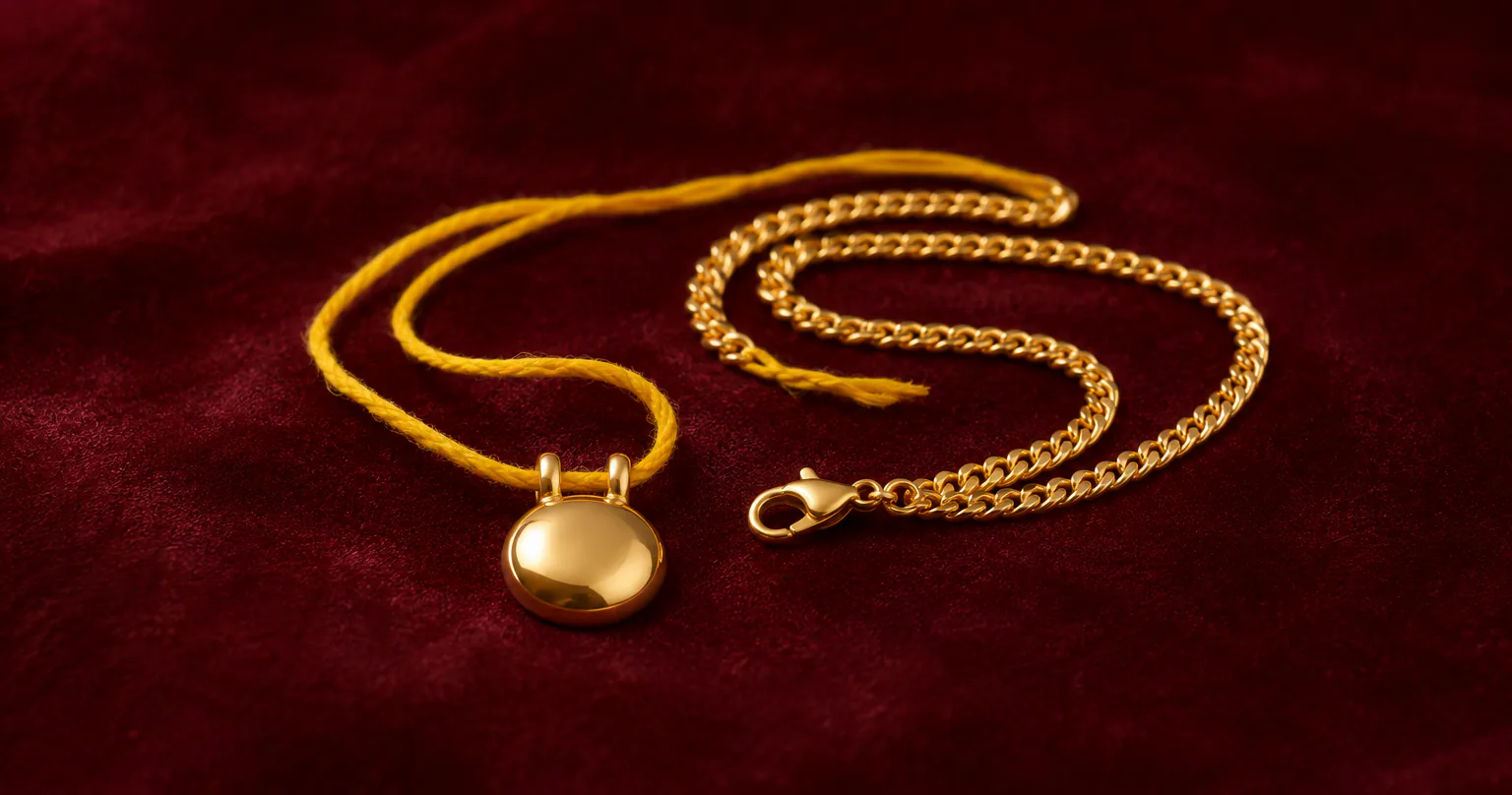
For many South Indian brides, the thali is the piece of wedding gold that stays on long after the wedding day. It is tied at the ceremony, often on a turmeric-yellow thread, and many families later move it to a gold chain for everyday wear. Here is what the thali is, how it relates to the mangalsutra, how designs differ between communities, and how to choose a thali chain you can wear every day.
The short answer: the thali is the gold marriage pendant that the groom ties around the bride's neck at many South Indian weddings. In North India the equivalent is called the mangalsutra. It is often tied first on a turmeric-coated thread, then moved to a gold chain, the thali kodi, on a later auspicious date. For daily wear, choose a strong 916 chain and judge it by its weight in grams.
What is a thali?
The Indian Heritage Centre describes the thali as "the principal marriage ornament or auspicious amulet placed on the wedding necklace". Its record traces the name to the palmyra palm: married women once wore strips of palm leaf tied around the neck as a sign of their status.
In Singapore, the National Heritage Board's entry on Tamil-Hindu weddings notes that the groom usually gives the thali, that local goldsmiths can customise it before the wedding, and that he ties it around the bride's neck during the ceremony. Many Tamil families also call it the thirumangalyam or mangalyam.
Thali or mangalsutra: what is the difference?
Both are marriage necklaces, given at the wedding and worn by a married woman. The names change by region, and the forms change by community.
| Community | Common names | What it often looks like |
|---|---|---|
| Tamil | thali, thirumangalyam, mangalyam | A gold pendant in the groom's family design |
| Telugu | mangalasutram, pustelu | Two round gold discs |
| Malayali Hindu | thali | Often a small leaf-shaped pendant |
| Malayali Christian | minnu | A small gold pendant bearing a cross |
| North and West Indian | mangalsutra | Black beads with a gold pendant |
These are broad patterns, not rules. Families within each community keep their own designs, and the groom's family usually knows which one is theirs.
Thali designs by community
Tamil thali designs vary most of all. A Malay Mail report on thalis in Malaysia explains that the design customarily follows the thali the groom's father gave his mother. Designs differ by community and by denomination, with separate designs for devotees of Shiva and of Vishnu. Families without a set design can choose a general one, such as the Pillaiyar (Ganesha) thali.
Singapore's museum collections show the range:
- A set of ten thali pendants made in South India and Singapore, in the Indian Heritage Centre's collection, includes an M-shaped pendant and an ammi (grinding stone) pendant, worn by some Tamil communities, and a pottu (hemispherical) pendant and a leaf-shaped pendant, more common among Malayalees.
- The Nagarathar Chettiar thali, the kazhuththu uru, is far larger: about 35 gold pieces strung on 21 lengths of turmeric-smeared string, around a central pendant called the ethanam. The Asian Civilisations Museum holds a 19th-century example from Chettinad.
If you need a particular family design, photograph an existing family thali or ask an elder for its name, then ask the jeweller whether it can be made to order.
From yellow thread to gold chain
At the wedding, the thali is often tied on a thread coated with turmeric, with three knots. The thread is commonly called the thali kayiru. Later, on an auspicious date chosen from the Tamil calendar, many families move the thali from the thread to a gold chain, the thali kodi. Some women add gold coins or other pieces to the chain over the years. Timing differs from family to family, so ask an elder or your family priest.
Aadi Perukku. On the 18th day of the Tamil month of Aadi, which falls in July or August, many married women renew the thread of their thali, and newly married couples join the prayers. In Singapore, Sri Mariamman Temple has held Thaali Perukku prayers on Aadi Perukku, with places booked through the temple office.
Thali kodi: what to look for in the chain
A thali chain carries a pendant every day, often for years, so strength matters more than fashion.
- Solid or hollow links. A solid chain is heavier for its size but resists dents and is easier to repair. A hollow chain is lighter and costs less, but dents and crushes more easily. See solid, hollow or gold-plated?
- Room for the pendant. Many thali pendants have loops at the back for the thread. Check that the chain and its clasp pass through them easily.
- Extras. Telugu thalis often have beads between the two discs, and some families add gold coins or beads to the chain. Ask for each extra piece to be weighed.
- A close, even weave. Very fine or open links catch on clothing and hair. Choose links that lie flat and feel smooth.
Choosing a thali chain for daily wear
- 916 gold. 22K gold is 91.6% gold, rich in colour and hard enough to wear every day.
- A secure clasp. A lobster or box clasp is easier to check than a simple hook. Ask the jeweller to show you how it locks.
- The right length. Decide where the pendant should sit: hidden under a blouse neckline or on show. Measure a chain you already wear and compare.
- A sensible weight. A heavy pendant needs a heavier chain. A light pendant can sit on a lighter one.
How much should a thali chain weigh?
There is no standard weight. It depends on the pendant, your family's custom and your budget. What matters is that you know the weight, because gold is priced by it:
- Gold value: the weight in grams multiplied by the day's 916 rate.
- Making charge: the craftsmanship.
- GST: 9% on jewellery, under IRAS rules.
Gold value is usually most of the bill. When the Victoria and Albert Museum bought a thali new from a Madurai jeweller in 1996, about 85% of the price was the gold and the rest was the goldsmith's work.
For one reference point, Tamil Nadu's government marriage assistance schemes give eligible brides an 8 gram, 22 carat gold coin "for making Thirumangalyam". That is one pavan, or sovereign. Many families count gold this way; see pavan, sovereign and tola in grams. A chain to carry the thali is a separate piece with its own weight.
Set your budget in grams, then ask for the pendant and the chain to be weighed separately on your receipt.
Caring for a thali chain
- Wipe it after a hot day. Sweat and skin oils dull gold. A soft cloth keeps it bright.
- Wash it gently. Warm water, a drop of mild soap and a soft toothbrush clean the links. Rinse and dry it well.
- Rinse after swimming. If you wear your thali day and night, rinse the chain in fresh water after a chlorinated pool.
- Check the clasp and the links where the pendant rubs. If a link looks thin or the clasp is loose, have it seen to before it breaks.
- Store it on its own in a soft pouch whenever you take it off.
Questions people ask about thali chains
What is the difference between a thali and a mangalsutra?
They serve the same purpose. "Thali" is the usual South Indian word, while "mangalsutra" is used in much of North India, often for a black-bead necklace with a gold pendant.
What is a thali kodi?
The thali kodi is the gold chain that carries the thali after it is moved from the turmeric thread.
When is the thali moved to a gold chain?
On an auspicious date after the wedding, chosen from the Tamil calendar. Families set the date in their own way, so ask an elder or your priest.
What is Thaali Perukku?
In Singapore, it is another name for the Aadi Perukku prayers at Sri Mariamman Temple. Aadi Perukku falls on the 18th day of the Tamil month of Aadi, when many married women renew the thread of their thali.
Can family gold be used for a thali chain?
Old gold can be traded in or remade into a new chain. Customs about reusing an older thali itself differ, so ask your family elders first.
Visit us
To compare 916 gold chains, or to ask whether a pendant can be made in your family's design, visit Minora Jewels at 142 Dunlop Street, inside Haniffa, in Little India, a few minutes from Little India (NE7, DT12) and Rochor (DT13) MRT stations. We are open every day from 10.30am to 9.30pm, and you can walk in without an appointment. Ask for the weight of each piece and today's price. Planning the whole set? Start with our Indian bridal jewellery checklist and our bridal jewellery page.