
How to tell if gold is real: tests that work, and myths
, 8 min read
A chain from an online seller, a bangle found in a drawer, a gift you were not sure about: sooner or later you may want to know whether a piece is real gold. The internet is full of quick tests with magnets, vinegar and teeth. A few of them can rule out an obvious fake. None of them can prove a piece is gold, or tell you its purity.
The short answer: home tests can only catch crude fakes. A magnet picks up steel or iron, but copper, lead and tungsten are not magnetic either, and vinegar, biting, streaks and skin marks cannot tell gold from gold plating. Only a professional test, such as XRF or a touchstone and acid test, shows purity. The safest course is an established shop and an itemised receipt.
What does a purity stamp tell you?
A stamp such as 916 is the maker's or seller's statement of the purity. It is a useful first check, but it is a claim, not a test. We explain the numbers and the marks in 916 or 999? Gold purity explained.
Fakes do get through. In 2021, the Singapore Police Force reported that pawnshops had been cheated of about S$51,000 by people pawning fake gold jewellery. If pawnshops, which handle gold every day, can be caught out, a stamp on its own is not enough.
Home tests: what each can and cannot show
The magnet test
Gold is not magnetic. Hold a strong magnet to the piece: if a piece sold as 916 gold is pulled firmly towards it, something is wrong, because it contains a magnetic metal such as iron, nickel or cobalt. The trouble is the opposite result. Copper, silver, lead, aluminium and tungsten do not stick to a magnet either, so a fake made from them passes.
The ceramic streak test
The idea is to rub the piece on the unglazed underside of a ceramic tile and look at the colour of the streak. It is a rough copy of the jeweller's touchstone test, minus the reference needles and acids that make that test work. Different karats of gold look very alike, so a gold-coloured streak cannot tell 9K from 22K, and a plated piece can leave a gold streak until you rub through the plating. It also scratches the piece.
The density or water test
Gold is very dense, 19.3 grams per cubic centimetre, so in theory you can weigh a piece, measure how much water it displaces, and compare. But a 10 g piece of pure gold displaces only about half a millilitre of water, far too little to read on a kitchen measuring jug. Alloy metals such as silver and copper are much lighter than gold, so the right figure depends on the exact alloy. Stones, hollow parts and trapped air bubbles throw the result off. Worst of all, tungsten has almost exactly the same density as gold, so a gold-covered tungsten core can pass.
Even with laboratory scales, a 1992 GIA study found this method the least suitable of the four it tested. Professionals still use it as one check: in 2024, a Singapore pawnshop reported a ring to the police for its low gold density.
Skin discolouration
Real gold can mark your skin. A black mark under jewellery, which doctors call black dermographism, is most often linked to gold. Makeup and sunscreens containing zinc oxide or titanium dioxide rub tiny particles off the metal. A green mark usually comes from copper, which is in most yellow and rose gold alloys, including 22K. We explain both in does gold tarnish?
The bite test
Pure gold is soft, so the old idea was that a tooth would dent it. But jewellery gold is an alloy, made harder than pure gold on purpose, and lead is soft too. A tooth mark proves nothing, and it marks the piece.
The vinegar test
Gold does not react with vinegar. It is chemically unreactive and dissolves only in strong acid mixtures such as aqua regia. But a gold-plated piece has gold on its surface too, so it also comes out of the vinegar unchanged. So even when nothing happens, you have learnt very little.
| Test | What it shows | Reliability |
|---|---|---|
| Magnet | Whether the piece contains iron, nickel or cobalt | Rules out some fakes; cannot prove gold |
| Ceramic streak | A rough streak colour | Low; cannot show karat; scratches the piece |
| Density or water | Whether the piece is roughly as dense as gold | Low at home; fooled by tungsten, stones and hollow parts |
| Skin mark | Very little | Not a test: real gold can mark skin |
| Bite | Whether the metal is soft | Not a test: lead is soft too |
| Vinegar | Whether there is gold on the surface | Cannot detect plating |
How professionals test gold: XRF, touchstone and fire assay
XRF (X-ray fluorescence). A machine fires X-rays at the piece and reads the X-rays its metals give back, which show what it is made of. It is fast and does not damage the piece. The Goldsmiths' Company Assay Office in London uses it wherever possible on finished articles. Its limit is depth: the readings come from only the first few microns below the surface, so thick plating over a different metal can read as gold. Shape, finish and calibration also affect the result.
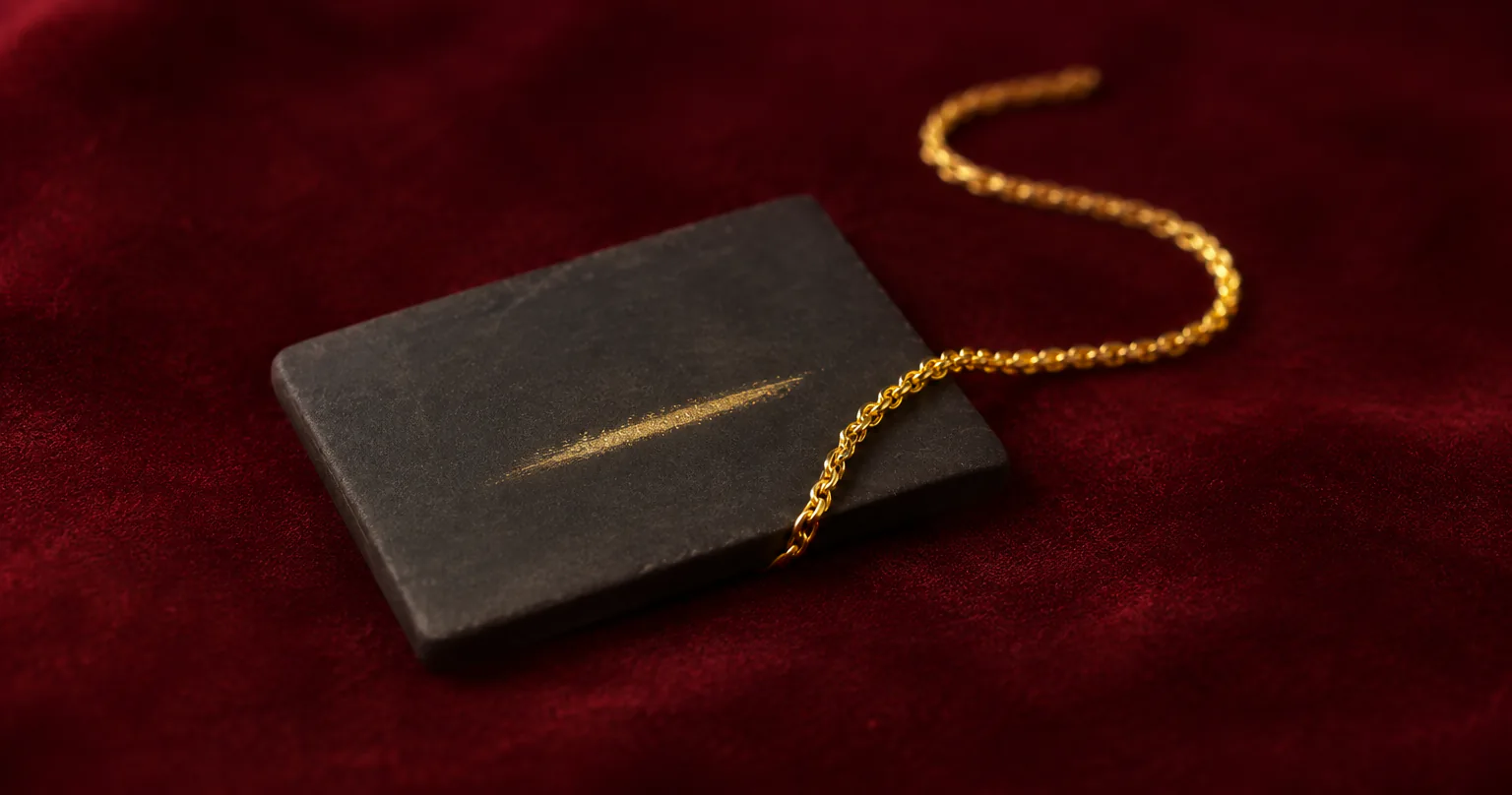
Touchstone and acid. The piece is rubbed on a fine-grained black stone, next to streaks from needles of known karat. Acid is drawn across the streaks, and the tester compares how each one reacts. It leaves only a tiny mark, works on most shapes, including stone-set pieces, and a skilled tester can spot plating.
Fire assay (cupellation). A small sample is cut or scraped from the piece, weighed, wrapped in lead with a measured amount of silver, and heated in a furnace at about 1,100°C. Everything except the gold and silver is absorbed, the silver is dissolved out in nitric acid, and the pure gold left is weighed. The London assay office puts its accuracy at about 1 part per thousand, and ISO 11426, the international standard for it, names it the recommended method for jewellery alloys. It removes metal, so it is not for a piece you simply want to check.
| Method | Damages the piece? | What it measures | Main limit |
|---|---|---|---|
| XRF | No | The surface layer | Plating can mislead |
| Touchstone and acid | A tiny streak | The metal at the rubbed spot | Depends on the tester's skill |
| Fire assay | Yes, a sample is removed | The whole sample | Destructive; laboratory only |
Plated, filled or solid gold?
Some of the hardest fakes to spot are base metal under a layer of real gold, which is why so many home tests fail. US trade rules give a sense of how thin that layer can be:
- Gold electroplate can be as thin as 0.175 microns. A layer of at least 2.5 microns may be called heavy gold electroplate.
- Gold filled means a layer of at least 10K gold bonded to another metal, making up at least 1/20 of the metal's weight.
- Solid gold is the same gold alloy all the way through. A hollow piece should not be called solid.
A karat number followed by letters such as GEP (gold electroplate) or RGP (rolled gold plate) describes the plating, not the whole piece. For how solid, hollow and plated chains compare, see solid, hollow or gold-plated?
How to buy gold safely
- Get an itemised receipt that shows the purity (for example 916), the weight in grams and the price. Keep it for when you sell, trade in or redesign the piece.
- Buy from an established shop with an address you can go back to. After a series of fake gold bar sales on Carousell in 2024, the Singapore Police Force advised buyers to use established and reputable retailers, and to have a professional verify high-value items before paying.
- Ask about buy-back. Ask whether the shop buys back the gold it sells, and how it would work out the price, so you know what the piece is worth to you later.
- Be wary of prices far below the day's gold rate. Gold is priced by weight and purity, so a much cheaper "916" piece is a warning sign.
Questions people ask about real gold
Does real gold stick to a magnet?
No. Gold is not magnetic, so a 916 piece that a magnet pulls firmly has a magnetic metal in it. A piece that is not pulled may still be fake.
Is the vinegar test accurate?
No. Gold does not react with vinegar, but neither does a gold-plated piece, so the test cannot tell them apart.
Can fake gold have a 916 stamp?
Yes. A stamp is a claim by whoever made or sold the piece, not an independent test. Buy from a shop you can go back to, and keep the receipt.
What is the most accurate gold test?
Fire assay, which assay offices use for gold and which is accurate to about 1 part per thousand. It removes a small sample, so for finished jewellery XRF and the touchstone test are more common.
Visit us
If you have old gold to sell, come to Minora Jewels at 142 Dunlop Street, inside Haniffa, in Little India, a few minutes from Little India (NE7, DT12) and Rochor (DT13) MRT stations. We sell 916 (22K) gold jewellery and buy gold for cash. We are open every day from 10.30am to 9.30pm, and you can walk in without an appointment. Ask us how we price selling your gold, or plan your visit.